Re-Post: The Legend of Zelda: Non-linear Or Not? - R.P. Lauer


Re-Post: The Legend of Zelda: Non-linear Or Not?
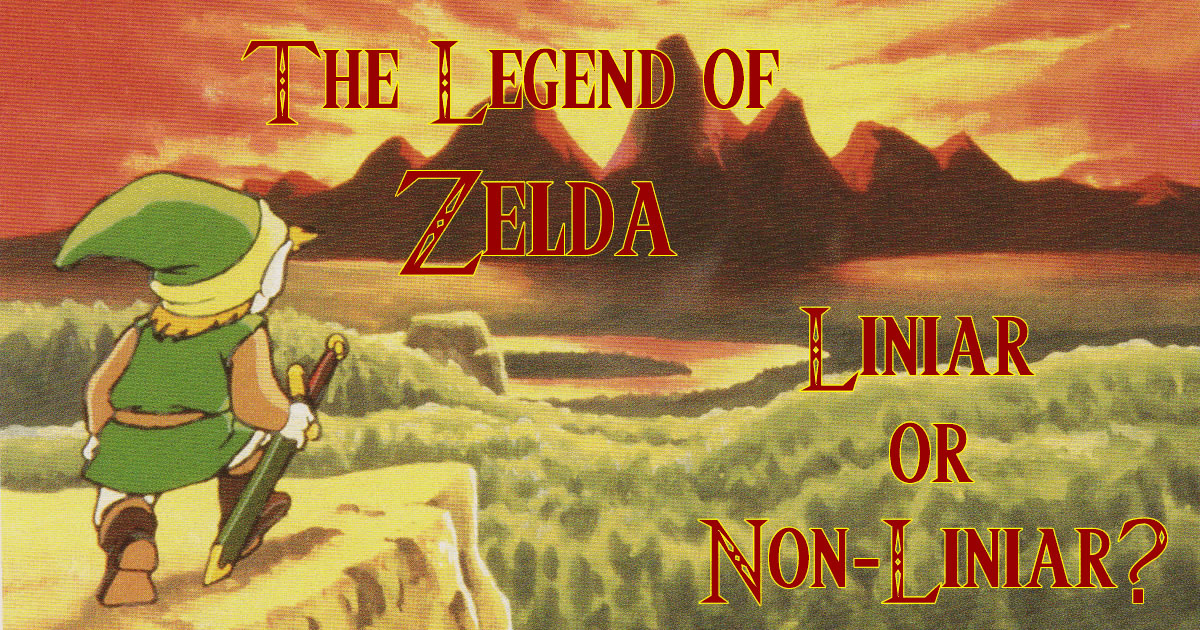


(The above image is taken from the book The Legend of Zelda: Art & Artifacts)
[2020 rewrite note: This blog was originally posted on August 23, 2017, and is the first of a very few old-site posts that I will be re-publishing. I'll clean it up slightly and add a few notes here and there, but the goal is to keep the original mostly intact.]
Disclaimer: The following write-up is focusing specifically on the First Quest of the original Legend of Zelda video game, released on the NES. I am not considering the games 'Second Quest', because not everyone who plays this game will play, or possibly even know about this optional Second Quest.
I recently decided to sit down and try writing up my thoughts and opinions on the no-longer-so-recent entry in the 'Zelda' series, The Legend Of Zelda: Breath of the Wild. My rough draft, which is still not even finished, was so long and all over the place that I decided to chop out aspects that were not actually directly relevant to that specific title. [2020 note: I never did finish any postings on Breath of the Wild. My thoughts on that went back on forth so much that I gave myself motion sickness. Oh well, maybe someday...]
One section was dealing with how many other people - critics and fans alike - compared the latest entry to its original release in how 'open' and 'non-linear' both games are. In fact (in referring to Breath of the Wild), many have said something along the lines of 'this is the most open-ended, non-linear game in the series since its original debut'.
As a long time and massive fan of the original title, when hearing this comparison, I can't help but ask; how well do you really remember the first game?
Don't misunderstand me; I do realize that the first title in the Zelda series was fairly open, with a lot of freedom; especially compared to the average Zelda title that would follow. But those choices are actually fairly limited when you really look at what needs to be done to complete the game. Also, I feel like most Zelda fans need to be reminded that the 2014 3DS title, A Link Between Worlds, was a thing, and was way more open and non-linear than the original release.
For those that need a generic recap, the original game started the player out in a mostly open world with nothing but a not-so-helpful small shield. On the same screen that you start in, there is a cave that contains a sword for you to use. After that, you have to find your way around a fairly large (for its time) map. Around this map are various enemies, shops, items, and secrets, as well as 9 dungeons to find.
Dungeon 9, which contains the final boss, cannot be accessed (even if found) until you have collected all 8 pieces of an item called the 'Triforce'. Each piece is hidden in the previous 8 dungeons, behind a boss that is at the end of a maze to be navigated. Each dungeon also contains at least 1 item that you, the player, can use along your way.
Now, right from the start, you CAN access most of the outer map if you know your way and are good enough to handle some of the harder enemies. And there is SOME choice to which dungeons you do first, and the order in which you do them is moderately open, to an extent. However, your freedom in dungeon order is not even close to absolute.
There is one dungeon in the game that can actually be found, explored, and fully completed in literally any order, and that is the 2nd dungeon. This dungeon would actually be relatively useless if it weren't for that piece of the Triforce which is required to gain entry to the final dungeon.
The second most flexible dungeon is probably dungeon 8, which can be navigated enough to get one of the two items it holds, beat the boss and retrieve its Triforce piece regardless of when you tackle it. However, if you mess up and unlock the wrong door, you will need to go buy a key from an over-world store unless you have the step ladder from dungeon 4. The second item in this dungeon can only be found if you have already gone through dungeon 1 and found the bow, as the second item in this dungeon is guarded by a Gohma, a crab-like creature that requires an arrow to the eye in order to defeat it.
Tackling dungeon 8 at the beginning of the game would be extremely tough as it holds highly difficult enemies, but it could be done by an expert player.
After that, however, the 'non-linear' nature is, well, fairly linear in reality.
Without going through every dungeon and what it requires, let's just look at dungeon 7. In order to even enter the dungeon, you must first have the whistle/recorder, found in dungeon 5. This means you need to do 5 before even finding 7. To get through 5, however, you MUST already have the ladder, as already noted, found in dungeon 4. Of course, to get to dungeon 4, you must first get the raft from dungeon 3.
So in order to do dungeon 7, you must first do dungeons 3 through 5. Also, dungeon 6 contains a previously mentioned Gohma, and requires the use of a ladder, so it too has prerequisites; dungeons 1, 3, and 4.
As I said before, the original Zelda game is fairly open in its over-world, and there is some choice in the order you can complete the dungeons, but that choice is very limited. Again, only dungeons 2 and most of 8 can be done quite literally in any order. All other dungeons either have prerequisite dungeons or is a prerequisite itself (dungeon 1 is a prerequisite to 6 and part of 8).
If a dungeon is part of a prerequisite, it cannot be saved for last; you would have had to already do it for some other dungeon.
Honestly, a better Zelda game to compare with Breath of the Wild in terms of openness and a 'non-linear' nature, would be the already mentioned A Link Between Worlds, as not too far into that game, you gain access to almost all of the games environment transversal items. But sadly, not many others have caught that similarity.
[2020 note: Something I had thought about back when I originally wrote this - but never quite articulated - is a thought about what people actually meant when they talked about how these two titles were similar. They would specifically say that they were both 'open' and 'non-linear', but what I think they really meant was that both games provide almost zero 'hand-holding'.
These are actually two very different things. A Link Between Worlds was extremely open and non-linear for a typical Zelda title, but it was still fairly heavy with its hand-holding; basically, the game almost forcibly guides you through how to play the game instead of just letting the player figure it out on their own. Breath of the Wild had very little, and the original provided absolutely none.]
[2020 rewrite note: This blog was originally posted on August 23, 2017, and is the first of a very few old-site posts that I will be re-publishing. I'll clean it up slightly and add a few notes here and there, but the goal is to keep the original mostly intact.]
Disclaimer: The following write-up is focusing specifically on the First Quest of the original Legend of Zelda video game, released on the NES. I am not considering the games 'Second Quest', because not everyone who plays this game will play, or possibly even know about this optional Second Quest.
I recently decided to sit down and try writing up my thoughts and opinions on the no-longer-so-recent entry in the 'Zelda' series, The Legend Of Zelda: Breath of the Wild. My rough draft, which is still not even finished, was so long and all over the place that I decided to chop out aspects that were not actually directly relevant to that specific title. [2020 note: I never did finish any postings on Breath of the Wild. My thoughts on that went back on forth so much that I gave myself motion sickness. Oh well, maybe someday...]
One section was dealing with how many other people - critics and fans alike - compared the latest entry to its original release in how 'open' and 'non-linear' both games are. In fact (in referring to Breath of the Wild), many have said something along the lines of 'this is the most open-ended, non-linear game in the series since its original debut'.
As a long time and massive fan of the original title, when hearing this comparison, I can't help but ask; how well do you really remember the first game?
Don't misunderstand me; I do realize that the first title in the Zelda series was fairly open, with a lot of freedom; especially compared to the average Zelda title that would follow. But those choices are actually fairly limited when you really look at what needs to be done to complete the game. Also, I feel like most Zelda fans need to be reminded that the 2014 3DS title, A Link Between Worlds, was a thing, and was way more open and non-linear than the original release.
For those that need a generic recap, the original game started the player out in a mostly open world with nothing but a not-so-helpful small shield. On the same screen that you start in, there is a cave that contains a sword for you to use. After that, you have to find your way around a fairly large (for its time) map. Around this map are various enemies, shops, items, and secrets, as well as 9 dungeons to find.
Dungeon 9, which contains the final boss, cannot be accessed (even if found) until you have collected all 8 pieces of an item called the 'Triforce'. Each piece is hidden in the previous 8 dungeons, behind a boss that is at the end of a maze to be navigated. Each dungeon also contains at least 1 item that you, the player, can use along your way.
Now, right from the start, you CAN access most of the outer map if you know your way and are good enough to handle some of the harder enemies. And there is SOME choice to which dungeons you do first, and the order in which you do them is moderately open, to an extent. However, your freedom in dungeon order is not even close to absolute.
There is one dungeon in the game that can actually be found, explored, and fully completed in literally any order, and that is the 2nd dungeon. This dungeon would actually be relatively useless if it weren't for that piece of the Triforce which is required to gain entry to the final dungeon.
The second most flexible dungeon is probably dungeon 8, which can be navigated enough to get one of the two items it holds, beat the boss and retrieve its Triforce piece regardless of when you tackle it. However, if you mess up and unlock the wrong door, you will need to go buy a key from an over-world store unless you have the step ladder from dungeon 4. The second item in this dungeon can only be found if you have already gone through dungeon 1 and found the bow, as the second item in this dungeon is guarded by a Gohma, a crab-like creature that requires an arrow to the eye in order to defeat it.
Tackling dungeon 8 at the beginning of the game would be extremely tough as it holds highly difficult enemies, but it could be done by an expert player.
After that, however, the 'non-linear' nature is, well, fairly linear in reality.
Without going through every dungeon and what it requires, let's just look at dungeon 7. In order to even enter the dungeon, you must first have the whistle/recorder, found in dungeon 5. This means you need to do 5 before even finding 7. To get through 5, however, you MUST already have the ladder, as already noted, found in dungeon 4. Of course, to get to dungeon 4, you must first get the raft from dungeon 3.
So in order to do dungeon 7, you must first do dungeons 3 through 5. Also, dungeon 6 contains a previously mentioned Gohma, and requires the use of a ladder, so it too has prerequisites; dungeons 1, 3, and 4.
As I said before, the original Zelda game is fairly open in its over-world, and there is some choice in the order you can complete the dungeons, but that choice is very limited. Again, only dungeons 2 and most of 8 can be done quite literally in any order. All other dungeons either have prerequisite dungeons or is a prerequisite itself (dungeon 1 is a prerequisite to 6 and part of 8).
If a dungeon is part of a prerequisite, it cannot be saved for last; you would have had to already do it for some other dungeon.
Honestly, a better Zelda game to compare with Breath of the Wild in terms of openness and a 'non-linear' nature, would be the already mentioned A Link Between Worlds, as not too far into that game, you gain access to almost all of the games environment transversal items. But sadly, not many others have caught that similarity.
[2020 note: Something I had thought about back when I originally wrote this - but never quite articulated - is a thought about what people actually meant when they talked about how these two titles were similar. They would specifically say that they were both 'open' and 'non-linear', but what I think they really meant was that both games provide almost zero 'hand-holding'.
These are actually two very different things. A Link Between Worlds was extremely open and non-linear for a typical Zelda title, but it was still fairly heavy with its hand-holding; basically, the game almost forcibly guides you through how to play the game instead of just letting the player figure it out on their own. Breath of the Wild had very little, and the original provided absolutely none.]
Thank you for reading my post! Please consider checking out my debut novel, The Scars of Gaia, here on my website! The entire novel can be downloaded for free in multiple digital formats.



dWeb Systems v2.0 Beta - ©2020-2025 R.P. Lauer
Some icons/graphics used were created by Yusuke Kamiyamane or Smashicons, DinosoftLabs, FreePik from Flaticon
Some icons/graphics used were created by Yusuke Kamiyamane or Smashicons, DinosoftLabs, FreePik from Flaticon
[ Last Updated: Tue, 27 Oct 2020 12:46:24 GMT ] [ Executed in 0.0173 seconds ] [ DB Queries: 17 ] [ Req Code: 200 ]